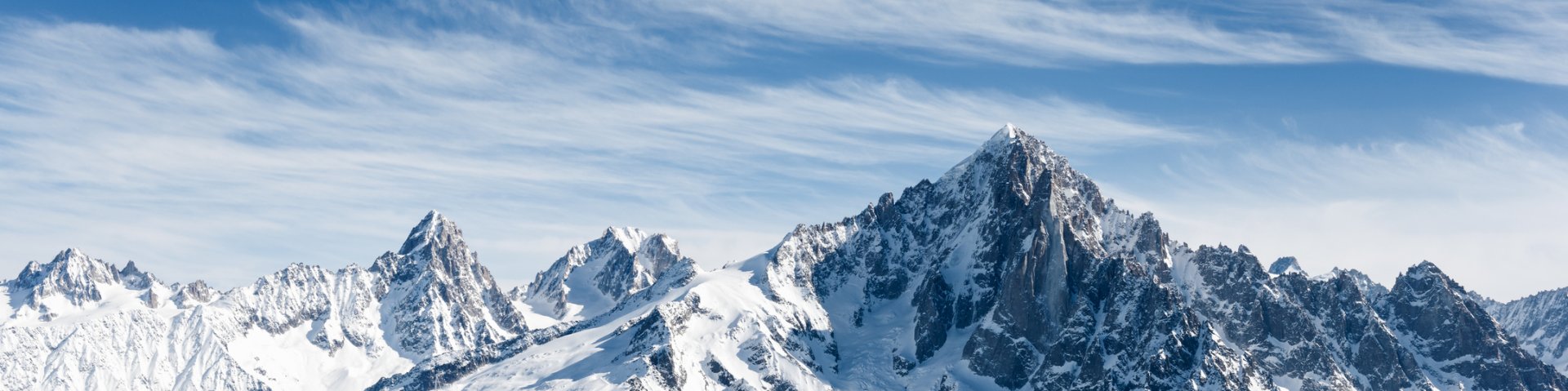
Travel to major natural sites to discover some of France’s most beautiful landscapes and get a bird’s-eye view!
Book a train ticket
Book a train ticket
From the peaks of the Alps and the Pyrenees to the summits of the volcanoes of the Auvergne region, with a view of Basque country or the Norman cliffs, it is time to go to higher ground!
France’s top 5 natural sites on high:
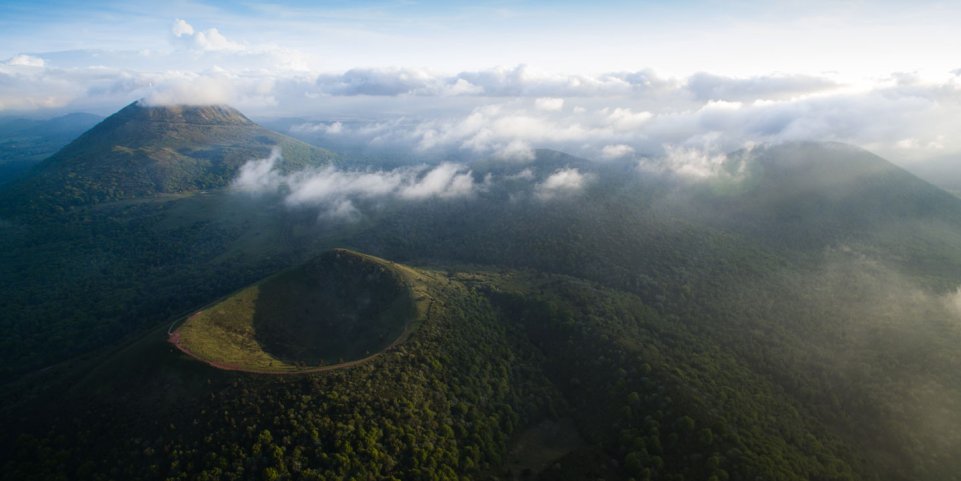
The volcanoes of the Auvergne region
The volcanoes of the Auvergne region, which range from 7000 to 65 million years old, are a natural wonder well worth visiting in the Massif Central. The Auvergne Volcanoes Regional Nature Park was created in 1977. It includes the Chaîne des Puys, Le Cézallier, the Massif du Sancy and the Massif du Cantal, and covers 389,733 hectares, making it the largest regional nature park in France!
The volcanoes of the Auverge region hold several records. Did you know that the Chaîne des Puy was the first natural site in France to be listed as a UNESCO World Heritage site in 2000? Or that the Massif du Cantal is home to Europe’s largest volcano, with a crater that measures nearly 70 km across? Or that there has been a train to the summit of the Puy de Dôme since 1907? The first rack railway transported you to the top of the volcano in just 2 hours, thanks to a steam-powered locomotive. The train is now powered by an electric locomotive, offering a much faster ascent, but the same stunning panoramic view of the Chaîne de Puys and Clermont-Ferrand!
There are all sorts of myths and legends about the volcanoes of the Auvergne region. You might hear tales of bewitched lakes, craters that lead straight to hell, and terrifying monsters such as the famous Bête du Gévaudan, but also more cheerful stories, such as that of the Fairy Rock, where powerful spirits are said to have created the city of Bourboule with a wave of their magic wands!
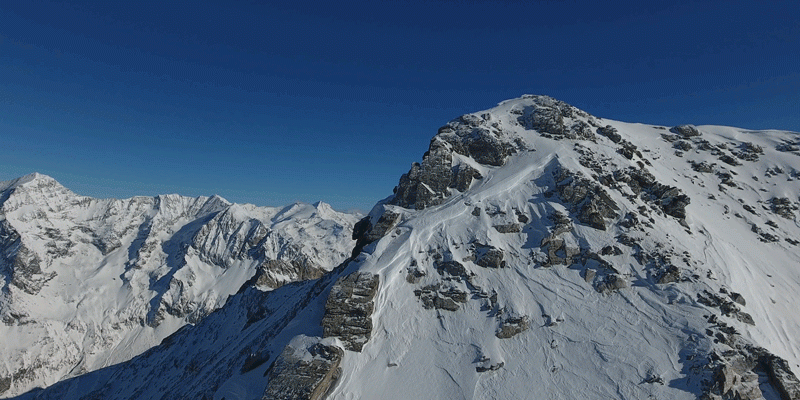
Mont Blanc
The Alps stretch across nearly 1200 km and span eight different countries. It is in this mountain range, and more precisely the Massif du Mont-Blanc, that you find the highest peak in western Europe: Mont Blanc! So, just how high is this giant of the Alps? It turns out the answer isn’t that simple. The height of Mont Blanc varies from year to year, depending on the snow cover. While its approximate height is generally considered to be 4800 metres, it actually measured nearly 4809 metres the last time it was measured in 2017.
Mont Blanc fascinates us with its extreme weather conditions and astounding elevation. It is a very symbolic place for mountain climbers. It is also the site of numerous challenges, records and amazing exploits! To mention just one: the first ascension of Mont Blanc, completed by Jacques Balmat and Michel Paccard in 1786, is considered as the beginning of modern mountaineering.
A symbol of success, it inspires people outside the world of mountain climbing as well, and has been the subject of many documentaries, films and books. Mont Blanc has also given its name to many brands, from desserts to luxury pens. Much more than just a mountain range, the snowy peaks of Mont Blanc are a veritable emblem of Europe!
The Pic du Midi
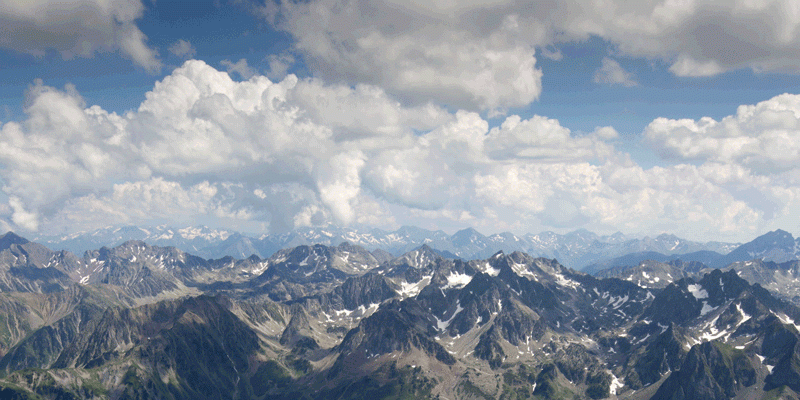
While it may not be the highest point in the Pyrenees, the Pic du Midi de Bigorre, which measures 2877 metres high, has been famous for hundreds of years. And with good reason: there are legends about it in Pyreneean mythology, a blend of Greek and local legends. Indeed, the Pic du Midi was already well known in Antiquity, albeit by a different name! That is one of the peak’s most unique features: first known as the “mountain of Arizes”, presumably because of the Arizes river that flows past its base, then as the “Pic du Midi de Bagnères”, the summit was only given the name of Pic du Midi de Bigorre in the late 19th century, “Bigorre” being the old name for the region.
Today, many hiking trails lead to the top of this mountain, while a cable car can also transport you to the panoramic viewing decks at the peak. They offer a 360° view of the Pyrenees! This is also where you will find the highest planetarium in Europe. You will also find a museum, a restaurant, a hotel and an astronomical observatory attached to the Observatoire Midi-Pyrénées. It is an Observatory of the Sciences of the Universe dedicated to researching unknown celestial phenomena.
This astronomical observatory is located on the Pic du Midi de Bigorre with good reason: the summit is at the heart of a dark sky preserve. The International Dark Sky Preserve of the Pic du Midi de Bigorre was certified in 2013 by the International Dark Sky Association. These preserves are intended to protect the quality of the night sky by limiting light pollution in a designated area — just one more reason to observe the stars from the Pic du Midi!

The Massif de la Rhune
If you are trying to reach the top of the Rhune mountain, which towers at 905 meters of elevation on the border between France and Spain in Basque country, you will be happy to hear that there is a pleasant, practical, eco-friendly option: the Petit train de la Rhune! This nearly hundred-year-old electric train runs on one of the last remaining rack railways in France, at an average speed of 8 km/h. The 4-kilometer route offers a superb 360° view of the Massif de la Rhune and the ocean down below. With a bit of luck, you may even see a Pottok, the iconic pony of Basque country!
The best part about the Petit train de la Rhune? It helps protect the environment where it runs, the French slope of the Massif de la Rhune, classified as a “Natural site - large landscape”. How? Well, the train is not only electric, but also self-sufficient! As one train descends, it produces electricity that enables another train to ascend the slope, in a virtuous, eco-friendly cycle.
Did you know that in addition to being home to many natural treasures, Rhune Mountain also once contained a different kind of treasure? Legend has it that the Massif de la Rhune was once home to the seven-headed snake Lehehn Sugea, who hid his treasure trove there. On the advice of Satan himself, a shepherd tried to steal the treasure by setting Rhune Forest on fire, but the gold and silver that spouted from the mountain was so hot that the shepherd was killed by the molten metal and the forest was ravaged by the fire. That explains why the Massif de la Rhune was bare for so long, before the plants finally grew back more beautiful than before!
The Orgues de l’Ille-sur-Tet
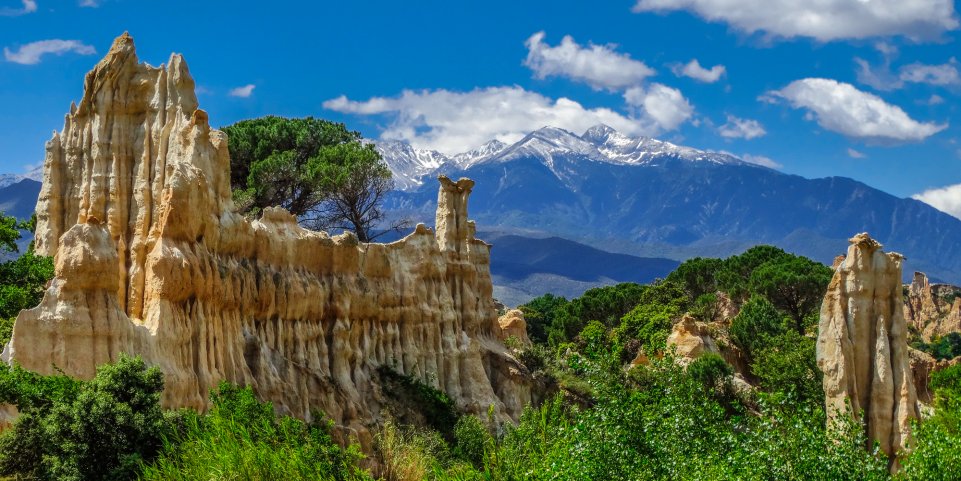
In the south of France, not far from Perpignan, you can admire a natural wonder that is almost unique in metropolitan France: the Orgues d’Ille-sur-Têt. This site offers hundreds of columns that rise 140 to 220 meters into the air. They are the result of millions of years of erosion of the sedimentary rocks in a region that was once under the sea. These geological curiosities have a name: “fairy chimneys”. The most famous are found in the region of Cappadocia in Turkey!
As their enchanting name implies, the fairy chimneys of Ille-sur-Têt naturally feature in many a local legend. There are numerous stories about this exceptional site, each more fantastical than the last. Some people believe the Orgues are home to elves or fairies. Others believe there is a giant, the Giant of the Orgues, who built the fairy chimneys himself and placed the “hats” on tops of the columns.