These days, clearing your mind is more important than ever. Travel to visit grandiose natural sites and some of France’s most beautiful landscapes near bodies of water.
Book a train ticket
Book a train ticket
Are you missing wide open spaces? We have made of list of some of France’s most beautiful natural sites to travel to while staying near the water. From the Calanques of Marseilles to Mont Saint-Michel Bay by way of the lakes of the Jura, there are plenty of magnificent landscapes to choose from!
France’s most beautiful natural sites near a body of water:
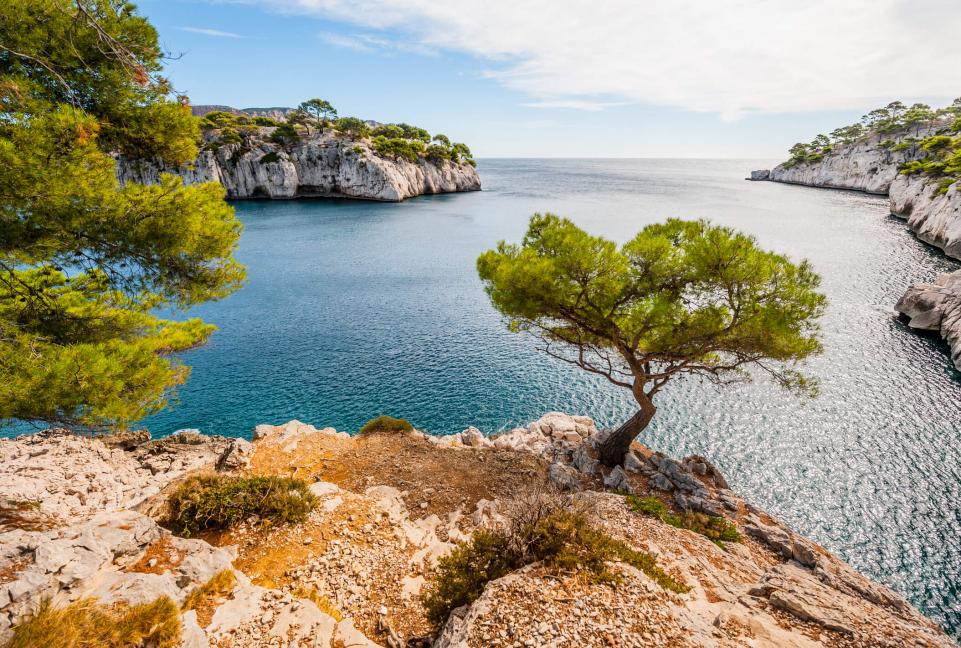
The Calanques of Marseilles
Near Marseilles, the Calanques stretch along 20 km of the coastline, forming a unique landscape for which the region is famous. The deep, narrow, uneven rocky inlets carved into the limestone mountains of Marseilleveyre and the Puget are a magnificent setting for hiking or taking a dip in the sea. This remarkable natural site has been a protected area since the creation of the Parc National des Calanques in 2012.
Today, visitors are more and more likely to catch a glimpse of dolphins playing in the water near the Marseilles Calanques. The Mediterranean is the natural habitat of blue-white dolphins, curious, playful animals that spend their time chasing schools of fish near the surface of the water. The region’s most famous Calanques are in Cassis.
But it is in a cave hidden away in the Calanques of Sormiou that you can find the Fontaine de Voire, which played a crucial role in the founding of the city of Marseilles. In 600 B.C., Greeks traveling from the city of Phocaea in Ionia arrived on the Mediterranean coast. A young man named Protis was sent to meet King Nann, the ruler of the native people, to negotiate for food and water. The king’s daughter, Gyptis, fell in love with Protis and gave him a cup of water from the Fontaine de Voire as a sign of her love. They married, and their union brought about a peaceful alliance between the two peoples.
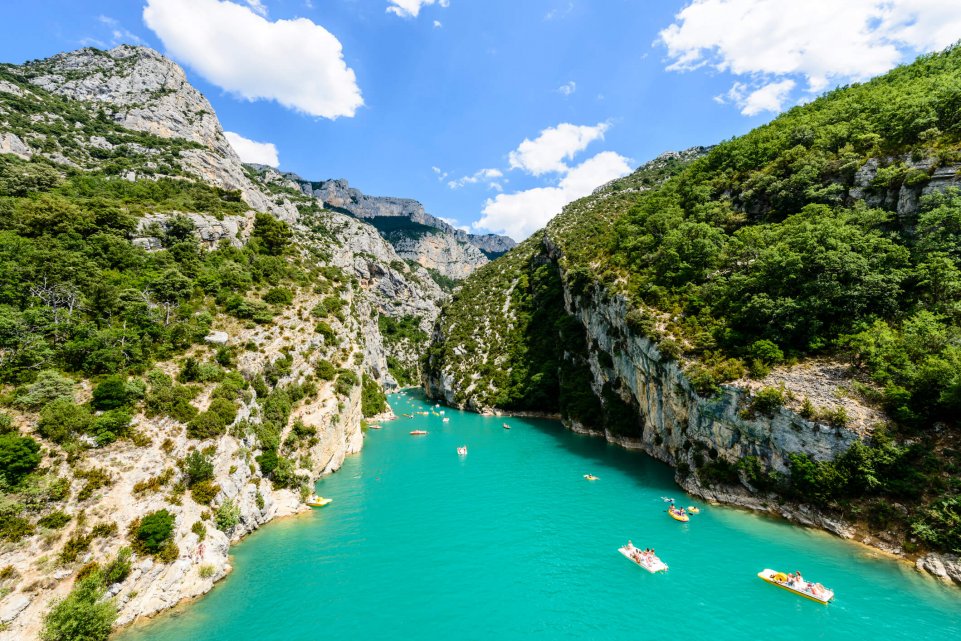
The Gorges du Verdon
The result of millions of years of erosion of the the plateaus of Haute-Provence by the Verdon river, the Gorges du Verdon wend their way through the towns of Castellane and Moustiers-Sainte-Marie, some fifty kilometers west of Manosque. The Gorges du Verdon form the largest canyon in Europe: they are 33 kilometers long, 6 to 1500 meters wide, and 200 to 700 meters deep. Between the limestone cliffs, the emerald-colored water, and the lakes, they make for a breathtaking scene.
There are many ways to enjoy the beauty of the Gorges du Verdon: hiking through the gorges, cruising down the river on a boat or a paddle boat, climbing the cliffs, swimming in the lake...or following one of the scenic routes to enjoy the stunningly photogenic lookout points. Did you know? The Route Napoleon follows the path the emperor took when he left Elba Island in 1815 to return to power in Paris. This itinerary combines beautiful scenery with an important piece of French history.
The Verdon Natural Regional Park offers several trails where you can enjoy the landscape and learn at the same time, thanks to the tourist booklets and informational signs: the trail from Le Lézard to Rougon , which follows a magnificent canyon of the Verdon; the gypsum loop, between Riez and St Jurs; the historic trail from Toine to Les Salles-sur-Verdon, a submerged city; a tour of the ghost village of Châteauneuf-les-Moustiers, and more.
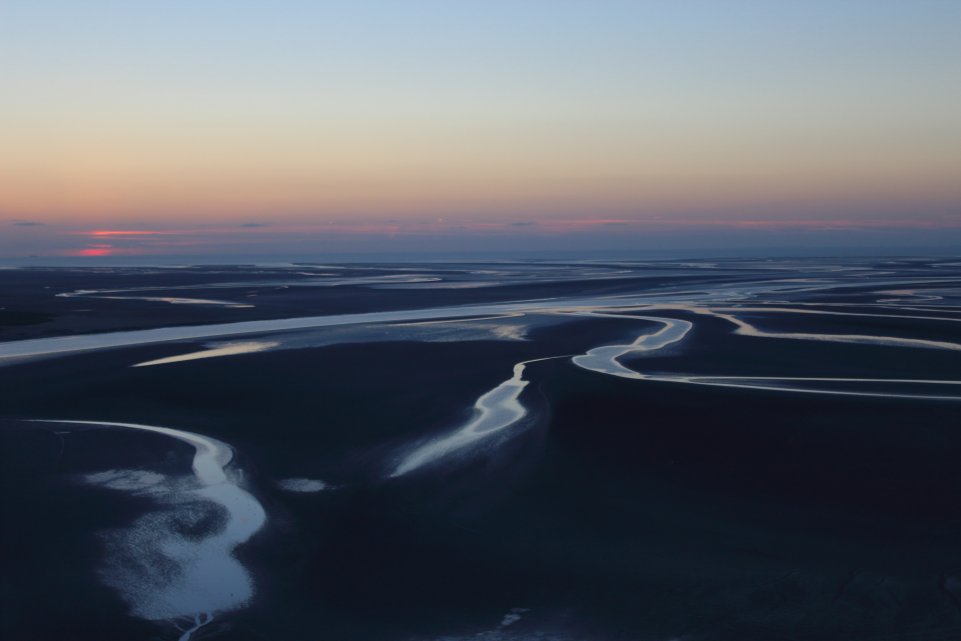
Mont Saint-Michel Bay
On the border between Normandy and Brittany, between Granville and Cancale, Mont Saint-Michel Bay is one of the most famous landscapes in Europe. Of course, most people go there to visit the Mont and its abbey, but the immense, unique bay is also an extraordinary natural site. Mont Saint-Michel Bay is on the UNESCO world heritage list for its magnificent maritime landscape; its tides, which are the biggest in France; France’s largest stretch of salt marshes and polders; its mussel farms, and more.
From the sandy beaches to the vegetation, the salt marsh lamb, the sky, the light, the reflection of the famous Mont Saint-Michel, the mussel beds, and the wilderness, everything comes together to create a truly magical picture-perfect setting.
The animals of the Bay are also worth noting: 130 different species of birds soar above the water, including seagulls and passerines, common scoters and Eurasian wigeons, as well as bean geese. The honeycomb worms, small sea worms, built Le Banc des Hermelles, an animal-made construction that measures more than 1000 hectares, the largest in Europe, with Some one hundred species of fish, including sole, skate, black seabream, and bar, as well as migratory fish such as salmon and eels, attract predators such as dolphinsand seals.
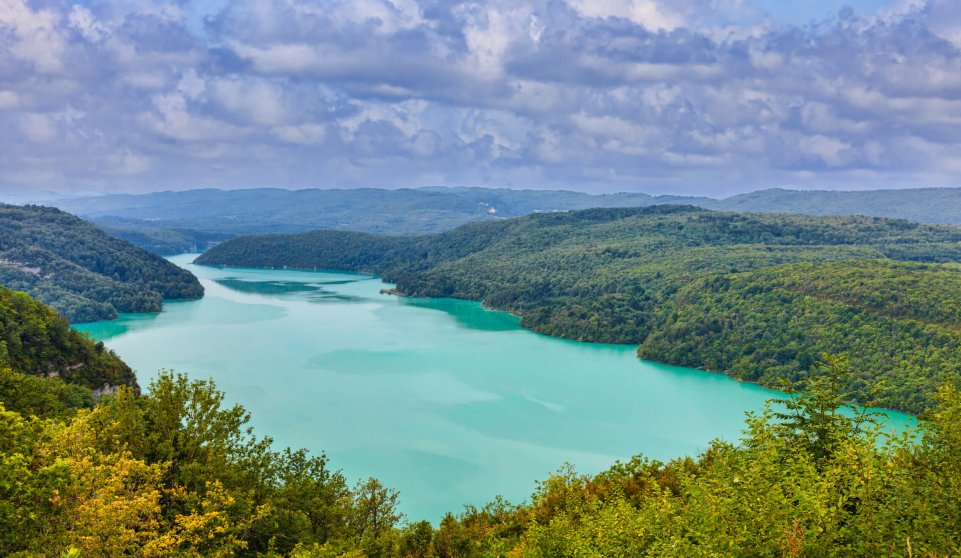
The lakes of the Jura
The Jura, a department in the Bourgogne-Franche-Comté region, follows the Jura mountains along the border between France and Switzerland, northwest of the Alps. The panoramic views of its lakes are like something out of a dream, and the peaceful setting lets you immerse yourself in a truly authentic slice of nature.
The 70 lakes of the Haut-Jura are a result of glacial melt. The Route des Lacs du Jura is a 150 km itinerary that takes you past some of the region’s most beautiful views, including the Pont de la Pyle over the Lac de Vouglas, the Cascades du Hérisson, the Belvédère des Quatre Lacs, and more. The Vallée du Hérisson and the Plateau des 7 Lacs are two connected sites included on the list of the Grands Sites de France. Between them, they include a series of lakes and 31 waterfalls (the largest series of waterfalls in France.)
Some of the Jura’s can’t-miss lakes:
- The Lac de Lamoura, at the foot of the Forêt du Massacre, is at the highest elevation of all the Jura’s lakes. It has a well maintained beach staffed by lifeguards during the summer, and space for ice fishing and ice skating when the lake is frozen and free of snow. You can also follow the trail around the lake on foot or by mountain bike during the summer, or with snowshoes or cross-country skis during the winter.
- The Lac des Rousses is the most heavily frequented by tourists, and offers numerous aquatic activities during the summer, along with hiking and outdoor ice skating during the winter.
- You can enjoy a view of Les 4 Lacs or “The Little Scotland of the Jura” from the Pic de l’Aigle hiking trail, which has an unobstructed view of the lakes.
- The Lac de Chalain is great for families in summer.
- The Lac de Clairvaux is the warmest in the Jura.
The legend of the underwater village
Legend has it that the village of Frasnois was flooded by the Lac de Narlay one Christmas night because of a witch’s curse. Her house, overlooking the lake, was spared. On Christmas Day, you can supposedly hear the village’s cock crowing from atop the submerged bell tower.
Did you know? Maurice Island is in the Jura.
The Lac du Vouglans, the third largest artificial lake in France, is known as the Emerald Giant. It is 35 km long and has three marinas and three well-maintained sandy beaches. You can take a little cruise on the Louisiane and even visit the lsland of Maurice for a change of scenery. This little island in the middle of the lake was named after a man named Maurice who spent a lot of time there in the 1990s. It’s a popular fishing spot when the water is high enough.
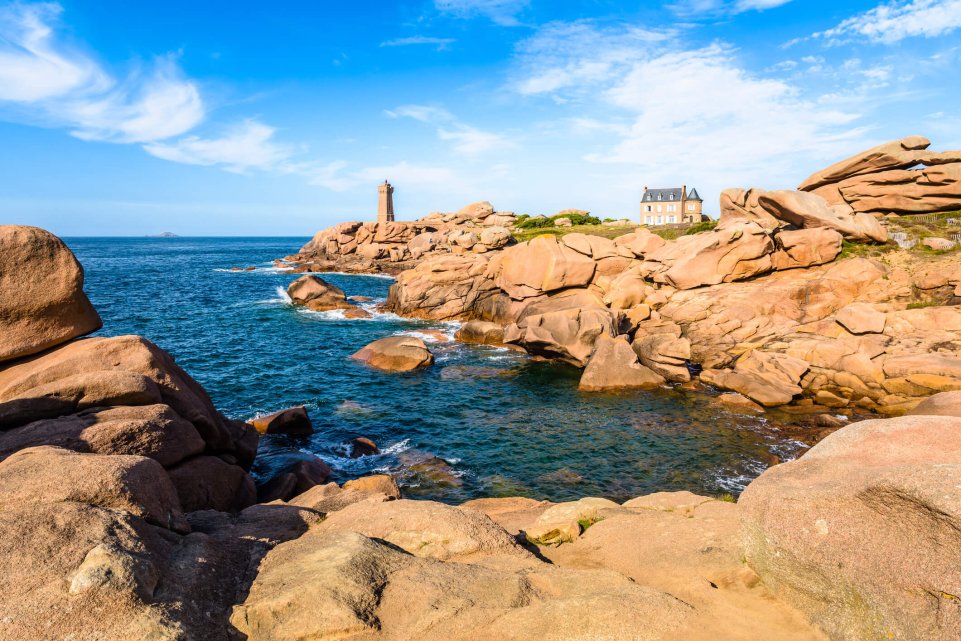
The Pink Granite Coast in Brittany
The Pink Granite Coast refers to some ten kilometers of coastline along the English Channel, in the Côtes-d'Armor, north of Brittany. The beauty of the coast comes from its stone, a pinkish-brown granite that is often found in jumbled heaps. The main towns are Perros-Guirec, a seaside resort and historic city, Pleumeur-Bodou, with its 12 beaches, Trébeurden, with its paleolithic menhirs, and Trégastel , known for its seabed. Just across from the Pink Granite Coast is the 7 îles archipelago, a Nature Reserve protected natural site. 27 species of nesting birds, including 12 species of marine birds, live there, including the Northern gannet, Europe’s largest sea bird. Another unique species worth discovering is the famous puffin!
The Pink Granite Coast has many unique natural phenomena worth appreciating: La Boule in Trégastel is a perfectly spherical stone found amidst a jumble of boulders. It is located at the tip of Ile Renote and is only accessible at low tide, and even then, takes some work to find. Nearby, there is a massive boulder weighing hundreds of tons that can be moved with a simple push of the hand. Erosion has shaped the rocks all along the coast, resulting in naturally rosy sculptures that are worth a visit. People have claimed to see a hippopotamus, a painter’s palette, a whale’s head, and even a crown among the boulders. The boulders and the natural landscape have been preserved since 1901, and this unique, copper-colored scenery continues to inspire artists today.
Did you know? There are only two other pink granite coasts in the world: one in Corsica, the Capo Rosso, in the Scandola nature reserve on the western part of the island; and one in China, on Qingdao (the green island!), in the Yellow Sea, between Shanghai and Beijing: quite the geological rarity!
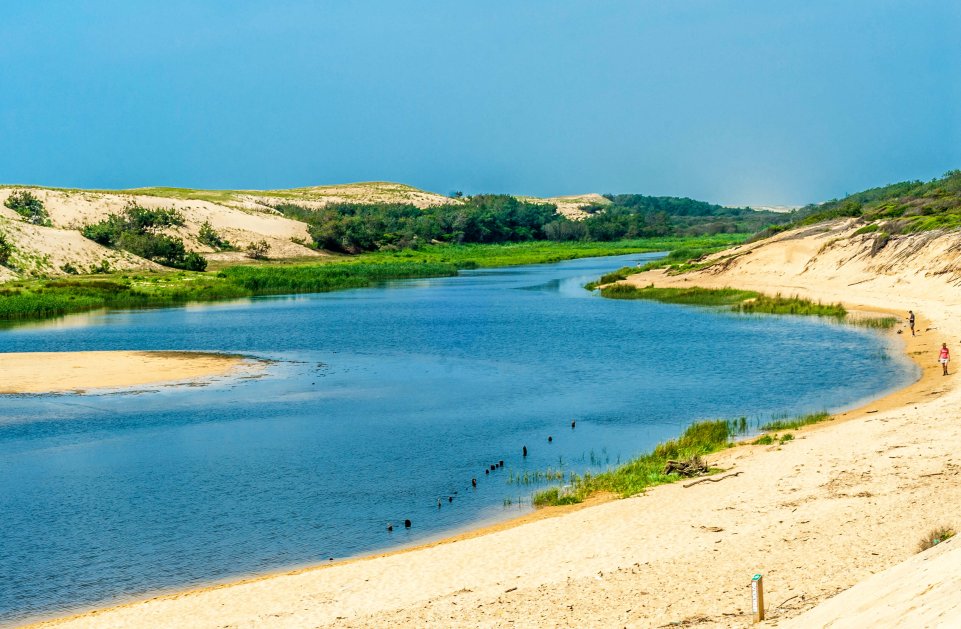
A unique nature reserve: Courant d’Huchet
The Courant d’Huchet is a stream from Les Landes that flows from Léon to the Atlantic Ocean, ten kilometers away. The Nature Reserve of the Courant d'Huchet is spread across three communes in the Pays des Landes de Gascogne, between Bayonne and Mimizan, and offers a wide variety of landscapes: from the dunes to the forest of Les Landes, by way of the marshes, peat bogs, and waterways, it is also home to some amazing flora and fauna.
Head to the observatory on top of a dune to observe the Marais de la Pipe and its inhabitants, then to the Mirador du Bois to spy on the birds of the humid zone. Keep your eyes peeled, and you might even be lucky enough to see a European mink, an endangered member of the Mustelidae family, a genet, or a Southwestern water vole. The woodland trails wend their way through the pine forest alongside the dunes.
A touching tale tells how some rare flowers came to grow in this little piece of paradise in Les Landes: it is the story of an Egyptian princess. Fleeing the invaders of her home country, she arrived by boat on the Courant d’Huchet, the only place that was peaceful enough and far enough away from Egypt for her to be satisfied. Upon her arrival, she laid down a hibiscus flower, which immediately bloomed. Some time later, to amuse the young princess, some ducks brought her another kind of flower: a carnation, which through some miracle flowered in the dunes just as quickly as the hibiscus did. Before returning home, the Egyptian princess gave one final flower to the Courant d’Huchet: the “everlasting”, or helichrysum, which blooms all year round.
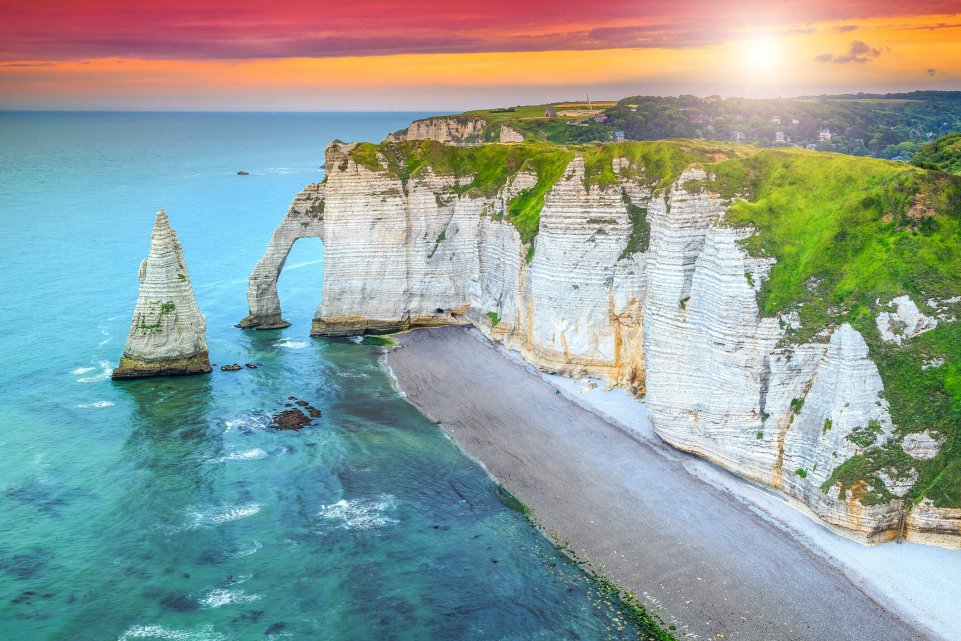
The cliffs of Etretat
Etretat, a seaside resort in Normandy, is famous for its beautiful white chalk cliffs shaped by the wind and sea over hundreds of years. They are most famous for three arches formed in the cliffs: the Porte d’Amont, La Manneporte, and the most famous of all, the Porte d’Aval, which also has a spire that reaches a height of 51 meters. For the best view of this majestic protected natural site, take one of the multiple trails leading to the tops of the cliffs!
The beautiful site has inspired numerous artists. Among them are Gustave Courbet and Claude Monet. One of Monet’s most famous paintings, Etretat, La Manneporte, is displayed at the Musée d’Orsay. Guy de Maupassant, for his part, finished Bel-Ami and wrote Pierre et Jean in the house he had built in Etretat.
The most famous story about the cliffs of Estretat is that of the gentleman burglar, Arsène Lupin. In his book The Hollow Needle, Maurice Leblanc uses the cliffs of Estretat as a place for his hero to hide his stolen treasures of inestimable value! You can follow in the footsteps of Arsène Lupin through a fun exhibit in the form of a cinematographic itinerary in 7 stages. The exhibit is found at the Clos Lupin, the author’s house, which has been turned into a museum. The voice of Georges Descrières, who played Arsène Lupin in the television show, guides the visitors along the way.