From the coastline to inland areas, from cliffs to the banks of the Seine, Normandy offers a wide variety of landscapes everyone should see at least once in their life!
Book a train ticket
Book a train ticket
The beach of Varengeville-sur-Mer, just steps away from Dieppe
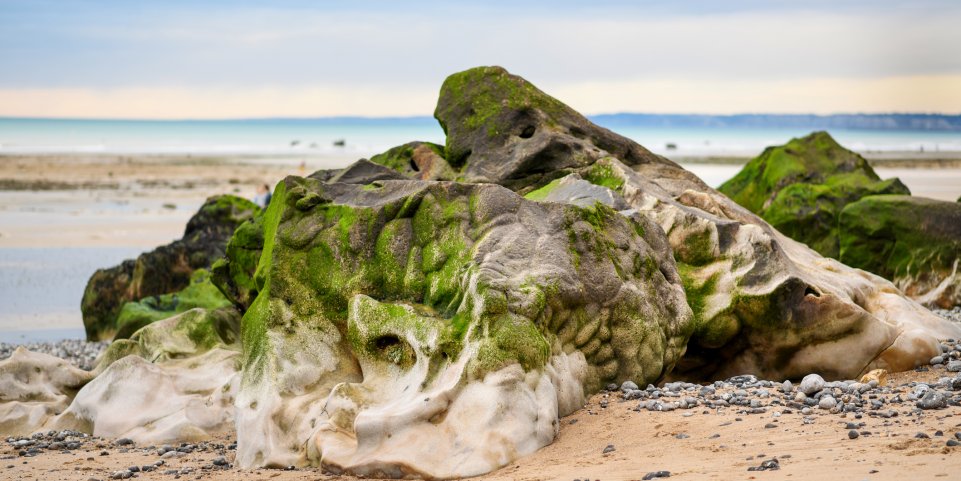
There are some places we prefer to keep secret, but no list of the most beautiful landscapes in Normandy would be complete without the beach of Varengeville-sur-Mer. Just a few kilometers from Dieppe, Varengeville beach is nestled between two cliffs that seem to be kissing one another.
The only way to reach this little-known beach is to follow a winding road that crosses multiple fields before reaching a parking lot big enough for some dozen cars. Many artists have found inspiration in this place, such as Claude Monet, Georges Braque and Jacques Prévert.
Getting there
Take the train to Dieppe, then rent a car with our rental service there. On the road from Dieppe to Varengeville-sur-mer, you will enjoy a panoramic view of the beach of Pourville-sur-Mer, which is also worth the detour and a few photos!
The best place for a photo
From the parking lot, if possible at sunset.
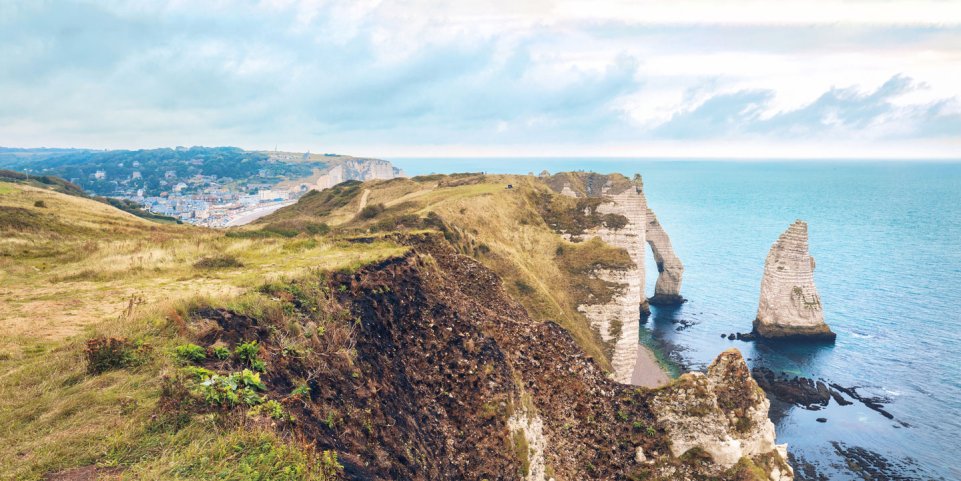
The cliffs of Etretat
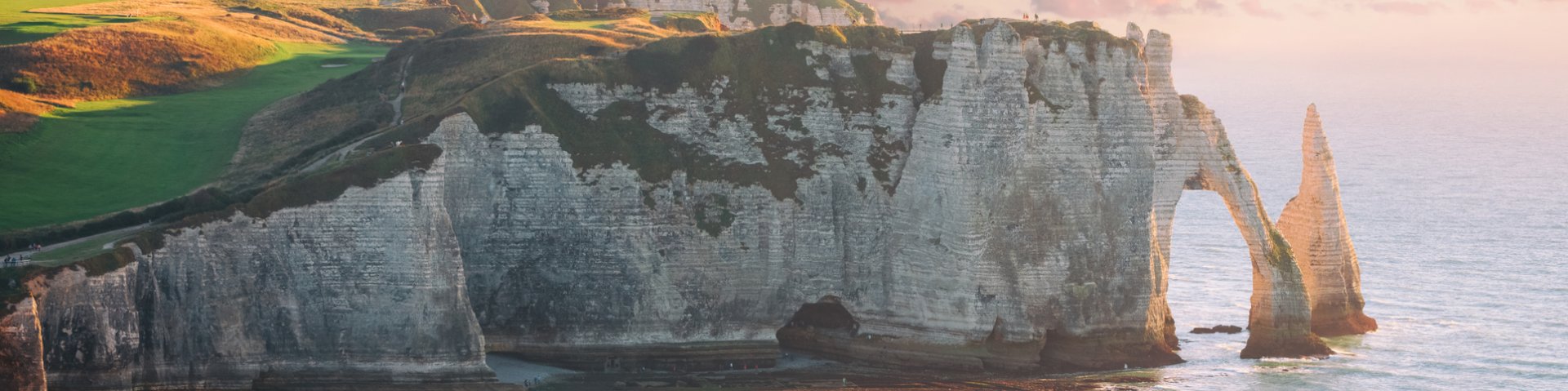
The most famous cliffs in the world, located in Etretat, as the name implies, have inspired numerous artists: Monet and other impressionists, but also, most importantly, Maurice Leblanc, who created one of the most famous literary thieves in history: Arsène Lupin. The Aiguille Creuse, or “Hollow Needle”, where the gentleman thief is said to have hidden his treasure, is the focal point of this scenery. The 55-meter tall mountain has a natural arch formed by a series of natural phenomena (an underwater river, than erosion by the sea).
As you admire the cliffs of Etretat, you can’t help but think about how, over hundreds and thousands of years, nature has shaped and magnified the landscapes around us.
Getting there
Take the train to Bréauté-Beuzeville, then take the bus directly to Etretat. Or, if you want to discover all the beauty of the region, hop on board a train to Le Havre, then rent a car at the station.
The best place for a photo
Above the Falaise d’Amont, where the Notre-Dame de la Garde stands tall. To get there, follow the path that leads upward from the Etretat beach.
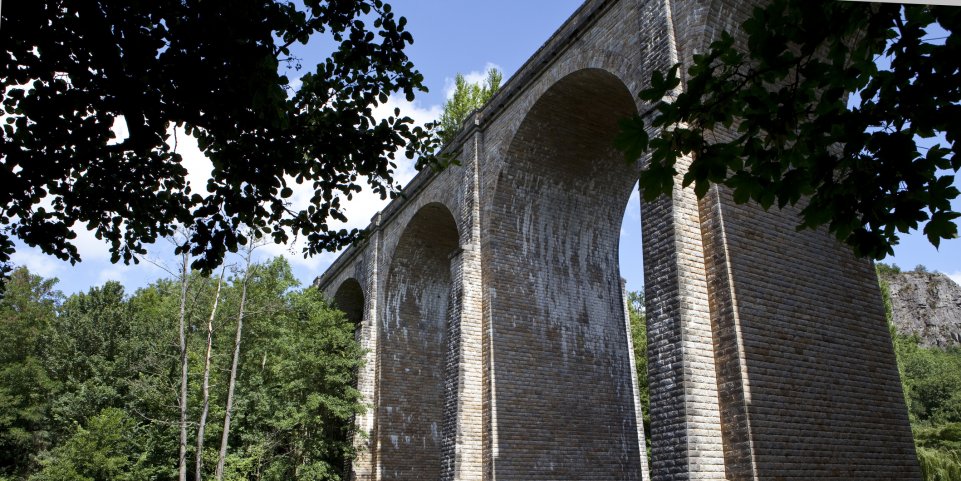
The Clécy Viaduct
While it may be less famous than the cliffs of Etretat, the Clécy Viaduct is also well worth a visit! This small monument overlooking the Orne is just a few kilometers from Caen. The viaduct was built in 1866 to connect the Berjou and Caen train stations. The stone bridge is composed of 9 arches and measures 108 meters long.
The best place to admire the view is from down below, on the banks of the Orne. If you have the chance to travel across it, you will catch a glimpse of the Calvados region, which extends along either side of the banks of the Orne.
Getting there
Take the train to Caen, then rent a car with our rental service.
The best place for a photo
From the water, of course, but if you don’t want to get wet, you can also get a lovely photo from one of the banks of the Orne!

Lyons la Forêt
Considered as one of the most beautiful villages in France, Lyons-la-Forêt is well worth the detour. This landscape, less focused on nature than the last few, offers a rich concentration of Norman architecture! The village near Rouen is most famous for its square and its covered market.
Below the village flows the Lieure, a perfect picnic spot on sunny days. But the best way to discover Lyons-la-Forêt (from my childhood memories, anyway) starts with a walk in the woods and ends with a hot chocolate drunk in the village square!
Getting there
Take the train to Rouen, then rent a car with our rental service.
The best place for a photo
From one of the corners of the square, making sure to include the covered market and the old Norman buildings around it in the photo.
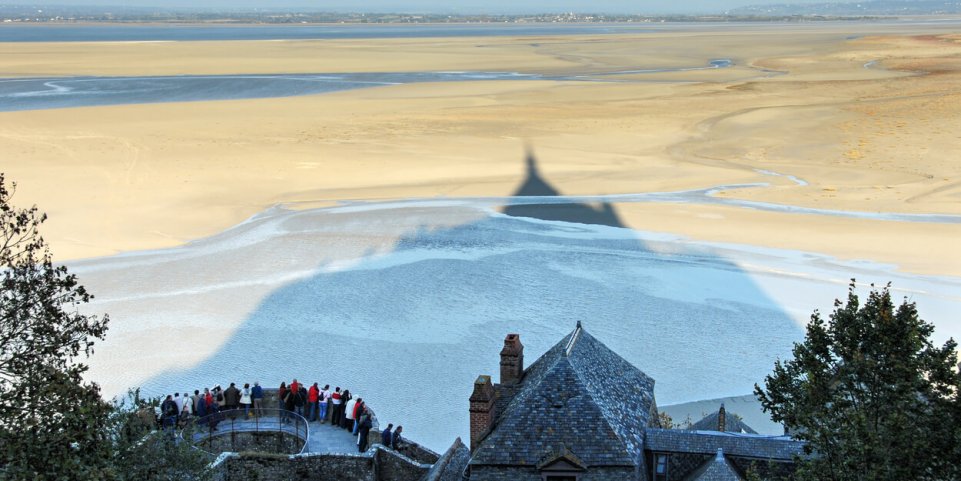
Mont Saint-Michel Bay from the mountain!
Obviously, one of the most famous landscapes in Normandy is without a doubt Mont-Saint-Michel and its bay! If you get the chance to climb the 360 steps to the summit of the Wonder, take the time to admire the view. You may not be able to get the archangel Gabriel in the photo, but you will have an exceptional view of salt marsh lamb, the sea as far as the eye can see, and the Breton and Norman coast, all of which is considered a UNESCO-listed World Heritage Site!
Getting there
Take the train to Mont-Saint-Michel and that’s it!
The best place for a photo
From the bridge, if you want the mountain in the frame, or from the top of the mountain, to focus on the magnificent bay down below!
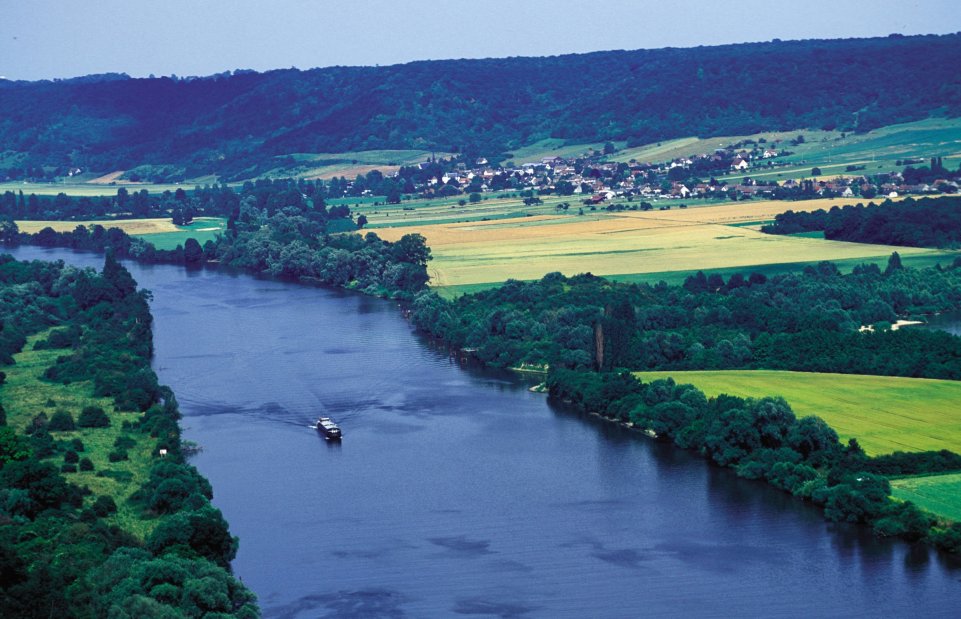
Boucles de la Seine park
The Seine takes a long and winding path before it finally reaches its estuary and flows into the waters of the Channel. It twists and turns, primarily between Rouen and Le Havre, where you will find the Boucles de la Seine Regional Nature Park.
It is especially popular every five years when the most beautiful boats in the world are present to take part in the Armada de Rouen, but this site is worth visiting all year round, simply to admire the incredible natural landscapes. One of the most beautiful is Jumièges, where the Abbey has stood strong above the Seine for many years.
Getting there
Take the train to Rouen, then rent a car with our rental service.
The best place for a photo
Either from below the Pont de Normandie at the end of the Boucles de la Seine Regional Nature Park, or in Jumièges.

The city of Honfleur
We can’t help falling in love with the beautiful fishing village of Honfleur! It is a sight that never gets old. It’s not a natural landscape this time, but rather half-timbered Norman houses, a small marina and a charming little square with a church, a perfect place to get away from it all. And if you want to leave with a lovely souvenir photo, take some time to photograph the port from all its different angles.
Getting there
Take the train to Deauville or Lisieux, then rent a car or take a shuttle to Honfleur.
The best place for a photo?
From anywhere in the port, you can’t go wrong! You can take your photos from facing the half-timbered Norman houses, or choose to stand in front of the bridge instead.

The Moulin de Vernon
If you go for a walk in Vernon, you will undoubtedly wonder about the funny-looking house that seems to be suspended above the water. Well, this “simple” half-timbered Norman house was actually once one of the many mills in the region. It was built in the 16th century atop a bridge connecting Vernon to the Vernonnet. Today, it is one of few buildings to be built on a bridge in France and guess who it inspired? Monet, of course!
>> Discover Monet’s house near Vernon
Getting there
Take the train to Vernon, then walk for a good 15 minutes to reach the Old Mill!
The best place for a photo
From one of the banks of the Seine, the one closest to l’Ile du Talus, on the same side as the Old Mill