
With its magnificent coastline and rich past, the Brittany region is the perfect destination for creating lifelong memories. Discover the region in pictures, through 6 can’t-miss sites!
Book a train ticket
Book a train ticket
When we think of Brittany, we think of its windswept coasts, mysterious forests and beaches with turquoise waters – in other words, its beautiful landscapes. And with good reason: it is one of the most beautiful regions in France! Here are 6 must-see sites in Brittany
>> Book my train ticket to Brittany

6 must-see natural sites in Brittany

Cap Fréhel
Unlike its name may lead you to believe, Cap Fréhel is not actually located in the commune of Fréhel, but in Plévenon, in the Côtes d’Armor. It is found on the western edge of the Emerald Coast, between the bays of Saint-Brieuc and Saint-Malo.
But what is Cap Fréhel? It is a long line of pink sandstone and schist cliffs 70 metres tall that form a point sticking out into the Channel. The cliffs of Cap Fréhel are without a doubt one of Brittany’s most beautiful natural sites. In addition to offering a breathtaking view of the sea and the Breton coast, they are covered with shimmering heathland grasses in the summer, and are home to hundreds of sea birds.
>> Discover Brittany’s most beautiful sunsets
In addition to being a Natura 2000 site and a Grand Site de France, Cap Fréhel is the perfect destination for nature lovers who want to be amazed while enjoying a breath of fresh air.
Getting there
Take a train to Lamballe, then hire a car with AVIS® or Budget®.

The medieval city of Dinan
The medieval city of Dinan, not far from Cap Fréhel, is also well worth the visit! The city is perched atop a hill overlooking the Rance River Valley, in an idyllic setting between the land and the sea.
With 3 kilometres of ramparts, a medieval castle decorated with flowers and narrow cobblestone streets lined with impressive timber-framed houses, Dinan is a perfectly preserved, charming, typical Breton city. As you wander through Dinan’s winding streets, you will come across many historic monuments, such as the Tour de l’Horloge overlooking the old city, the massive Saint-Sauveur Basilica and the port, which is hidden down below.
Continue your tour by following the river to visit more peaceful, bucolic villages in the area.
Getting there
Simply take the train to Dinan!

Bénodet
Are you looking for a mix of beaches and countryside? It is possible to combine the two! Just head 15 kilometres south of Quimper, to the heart of the “Breton Riviera”, in Bénodet. Although it is the largest seaside resort in the Finistère, Bénodet has maintained its small-town charm, making it the perfect spot for a stroll in any season.
With its long white sand beaches and turquoise waters, combined with well maintained trails on the banks of the Odet river and all around the commune, Bénodet has something for (nearly) everyone. The resort, which deserves its 5-star status, also has two ports, two lighthouses and a curious building shaped like an ocean liner, nicknamed “Le Minaret”, offering plenty of places to visit while you enjoy the relaxed ambiance that reigns in Bénodet.
Getting there
Take a train to Brest, then hire a car with AVIS® or Budget®.

The Carnac stones
Nearly 3000 stones in hundreds of lines, hundreds of metres long, covering several dozen square kilometres: the Carnac stones are the largest collection of megalithic standing stones in the world. This extraordinary site in Morbihan is home to standing stones of all sizes, which were erected by our ancestors in the neolithic period. They have withstood the tests of time, and while some show signs of damage, the site is exceptionally well preserved overall. Today, the stones are protected Historic Monuments.
In addition to the standing stones, the Carnac region is also home to a large number of prehistoric monuments. The area’s hummocks, burial mounds and dolmens are symbolic sites that attest to an important turning point in human history: settlement. The good news is that most of them are open to the public.
Getting there
Simply take the train to Carnac!
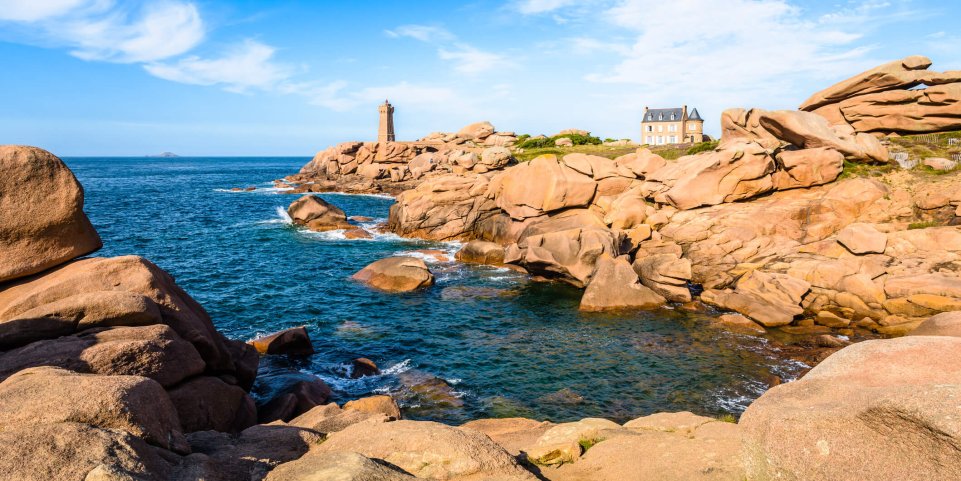
The Pink Granite Coast in Ploumanac’h
You can find other curious rocks, sculpted by the sea, this time, in the Perros-Guirec area, and more specifically, in the city of Ploumanac’h, on the Pink Granite Coast.
The site is so strikingly beautiful that it is difficult to describe. The best way to enjoy it is by taking one of the many curated trails along the coastline, such as the Sentier des Douaniers. This route is the perfect place to discover a unique natural treasure: kilometres of pink stones sculpted and transported by the power of the wind and the sea, sometimes covered with colourful heathland, sometimes marked by inlets covered with pale sand. The result is almost surreal, like something out of a fairy tale.
The Pink Granite Coast is a perfect place for a walk or, for athletic types, a longer hike, to discover the Breton coast in all of its splendour.
Getting there
Take a train to Lanion, then hire a car with AVIS® or Budget®.

Brocéliande Forest
Known for its legends and mysteries, Brocéliande Forest is well worth the visit. The legendary forest imagined by poet Chrétien de Troyes in “The Knight of the Lion” in the Middle Ages, Paimpont Forest aka Brocéliande Forest, is both beautiful and mythical. Between the twisted trees of the Val sans Retour, the stones of the Barenton fountain and the tomb of Merlin, along with the waterfalls and streams found throughout the forest, magic is everywhere you look in Brocéliande Forest.
Another major draw of this forest is that it is perfect for children. Between the marvellous tales that suffuse the forest, the beautiful landscapes, the mysterious sounds and the smells, Brocéliande will charm children and adults alike!
Getting there
Take a train to Rennes, then hire a car with AVIS® or Budget®.