
Nîmes, the capital of the Gard region, located in Occitanie and equidistant from Montpellier, Arles and Avignon, is easily accessible by train. It’s the perfect place for a city break, offering a blend of ancient history and southern specialities, outdoor activities and places to discover.
Book a train ticket
Book a train ticket

1. The Arena of Nîmes
The Arena of Nîmes is a Roman amphitheatre built around 90 A.D. as a site for gladiator games to entertain the colony of Nemausus. In the Middle Ages, the locals built houses inside the Arena, which became a fortified neighbourhood. Today, it is used for a variety of festivities including ferias, concerts, historical reenactments, escape games and more.
Visiting the Arena
Choose whichever type of visit you prefer: with a self-guided tour, you can take your time and learn more about the site by reading the signs or listening to an audio guide. Guided tours are available at no extra charge during the two summer months, five times a day, from Monday to Friday. Or you can choose a “visioguide”, an iPad mini, for an augmented-reality experience inside the Arena.
The Arena in numbers:
- Built: 1st century
- A listed historical monument since 1840
- Dimensions: 133 meters long and 101 meters wide
- Track: 68 m by 38 m
- Capacity: 13,000 seats
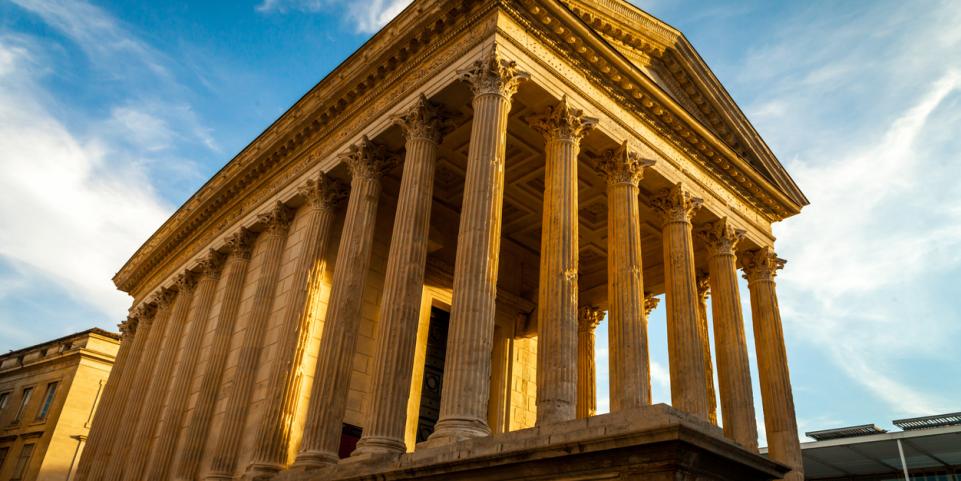
2. The Maison Carré
This ancient monument is said to be the best preserved in France and the only intact Roman temple in the world. The Maison Carrée was built between 20 and 12 B.C. above the city Forum.
Visiting the Maison Carrée
The building is 26 m long and 17 m tall with Corinthian columns all around it, and has 15 steps leading to the vestibule, then the former sanctuary, where a statue of a divinity once stood. Over the years, it has served as a consular residence, canon house, stable, prefecture headquarters and home for the departmental archives.
The projection room today
Inside, the room is dark and a film is shown: "Nemausus - the Birth of Nîmes". It tells the story of a family in the time of the Celts, when Gallia Narbonensis was occupied by the Volcae, from 55 B.C. until 90 A.D. when the Romans arrived.
The film is shown continuously, so feel free to join the screening whenever you like.

3. The Musée de la Romanité
5000 works retrace 25 centuries of history with 65 multimedia displays, including immersive projections, interactive maps and more
The four sections of the Musée de la Romanité:
- Ancient Gaul before the Romans arrived
- The Roman period
- The Middle Ages
- The legacy of Antiquity
The rooftop
We suggest visiting the museum rooftop for an impressive view of the city’s most important buildings.
Open every day except Tuesday from 10 am to 5:30 pm November through March, and every day from 10 am to 6:30 pm from April through October.
The archaeological garden
The archaeological garden is located at the foot of the museum. It contains 3500 m2 of green spaces and an arboretum from Nîmes’ past. The three levels of the garden correspond to the three periods found inside the museum.
It is open to the public free of charge every day from 10 am to 7 pm November through March, and 10 am to 8 pm the rest of the year.
The restaurant “La Table du 2”
This brasserie located on the third floor of the Musée de la Romanité with a view of the Arena is manned by Michelin-starred chefs and has a menu created by Franck Putelat,
Open every day from 12 pm to 3 pm and 7 pm to 11 pm. Phone: 04.48.27.22.22

4. The Jardins de la Fontaine (and La Tour Magne)
Located on the edge of Nîmes’ city centre, the Jardins de la Fontaine are worth the visit for both their charming flora and their historic importance.
The gardens
Louis XV had these gardens built in 1745 on the site of the city’s original spring and ancient ruins.
This “remarkable garden”, as named by the Minister of Culture, has two different sections: a classic 18th-century garden, and a landscaped Mediterranean garden.
La Tour Magne
You can reach this Gallo-Roman monument by way of a pleasant walk through the gardens. This tower was once part of the Roman wall around Nîmes. Today, the visit includes a multimedia table and describes how the city of Nîmes and the Tour Magne have evolved over time. At the top of La Tour Magne, you will find an orientation table and an impressive view of the city.
The Temple of Diana
The ruins of the ancient Temple of Diana are a symbol of the city’s Roman past. This romantic part of the garden located quite near the entrance is very popular with romantics.
The spring of the Fountain
The Fountain sanctuary is an ancient place of worship and the site of the original spring the city was built on.

5. The Carré d'Art
The Carré d’Art, located across from the Maison Carrée and not far from the Arena, is Nîmes’ museum of contemporary art. This building designed by British architect Norman Foster and inaugurated in May 1993 is made entirely of glass to play with light and reflections of the ancient buildings nearby.
Visiting the “museum of France”
The Carré d’Art has officially been named a “museum of France”. Its collection covers art history from 1960 to today with a special focus on artistic movements that have ties to southern France, such as New Realism, Supports/Surfaces, and Free Figuration. Here you will find Arte Povera, American art, German paintings by the likes of Gerhard Richter and Sigmar Polka and works by French contemporaries such as Sophie Calle and Annette Messager, as well as a small photography collection and special installations.
The exhibits change each year. The museum also hosts temporary exhibits of an international calibre showcasing different artists and artistic themes.
Activities at the museum
Workshops for children ages 6 to 12 offer the opportunity to discover different works housed in the museum and to experiment with a variety of artistic techniques
Certain Wednesdays from 2 to 4 pm, excluding school holidays and weekdays during holidays in the Gard. Booking required.
A guided tour of the collection is offered every Saturday and Sunday, and every day during school holidays, at 4:30 pm. The first Sunday of each month and the last Sunday of each exhibit, the tour is offered twice, at 3 pm and 4:30 pm.

6. The Musée du Vieux-Nîmes and other museums
Housed in the former episcopal place, the city museum, a listed Historical Monument built in the 17th century, preserves and teaches about the history of Nîmes dating back to the Middle Ages.
Visiting the museum
Much of the museum’s collection is dedicated to the textile industry in the 17th and 18th centuries. Nîmes was well known for its shawls, which were exported all over Europe in the 17th century, and for canvas “de Nîmes”, otherwise known as denim. The Cone spinning mill became the exclusive supplier for Levi Strauss in 1922. Yes, that’s right, the cowboys owe their signature look to Nîmes!
The museum also hosts temporary exhibits.
Other museums in Nîmes
- Le Museum - natural history museum and planetarium
13 Boulevard Amiral Courbet - 04.66.76.73.45 - Closed on Mondays
- The Musée des Beaux Arts
Rue de la Cite Foulc - 04 66 76 71 53 - Closed on Mondays
The chronological journey takes you from the Italian schools of the 14th century through the 18th century, to the Northern artists of the 16th century through the 18th century (Rubens), and French painting from the 17th century through the 19th century. You can also see the most beautiful Roman mosaic discovered in Nîmes.

7. Les Halles
Les Halles is Nîmes’ covered market, which is air conditioned in summer. You can also eat lunch there, as it is home to two restaurants and all manner of local specialities:
- “Brandade de Nîmes”, made with salt cod combined with olive oil and a bit of milk. It is served hot, in puff pastry or mixed with mashed potatoes.
- AOC winesfrom the Costières-de-Nîmes and the Coteaux-du-Languedoc
- AOC Nîmes olives and olive oil
- Tapenade, a spread made of black or green olives with capers, anchovies, herbes de Provence and olive oil.
- The “Crocus de Nîmes”, a Gallo-Roman toasted ham and cheese sandwich.
- Nîmes strawberries, starting on March 15th.
- Lamb from Nîmes
8. A restaurant worth trying
Vincent Croizard
In a narrow street not far from the Carré d’Art, you can find a charming 19th-century home, the domain of self-taught chef Vincent Croizard and his wife. His creative cuisine is inspired by the flavours of Provence and the Languedoc. On nice days, the outdoor seating area with a small pond in the middle is the perfect setting for a meal.
Closed on Mondays and Tuesdays -17 rue des Chassaintes - 04 66 67 04 99

9. The Gambetta neighbourhood for street art
Nîmes’ Gambetta quarter has been a popular, unusual location ever since its streets became a gallery for street artists from all over France. Graffiti artists and skaters flock to this part of town, to such an extent that some people call it “Little Berlin”!
In September and October each year, the street art festival known as L’Expo de Ouf sees a few new frescoes come to life. Stroll through the streets of Rue d'Orléans, Rue de la Baume, Rue Clérisseau, Rue d'Aquitaine and Rue des Bons Enfants to check out new and old works alike.

10. The Pont du Gard
The Pont du Gard, a UNESCO-listed world heritage site is the most frequently visited ancient site in France.
Of course, you will want to visit the charming site and the impressive aqueduct itself, but it’s also worth taking some time to check out the adjoining museum to learn more about the bridge through an array of models, maps and videos.
There are several ways to enjoy the site, including canoeing down the gorges of the Gardon or taking a dip in the water.
Take the B21 bus from Nîmes